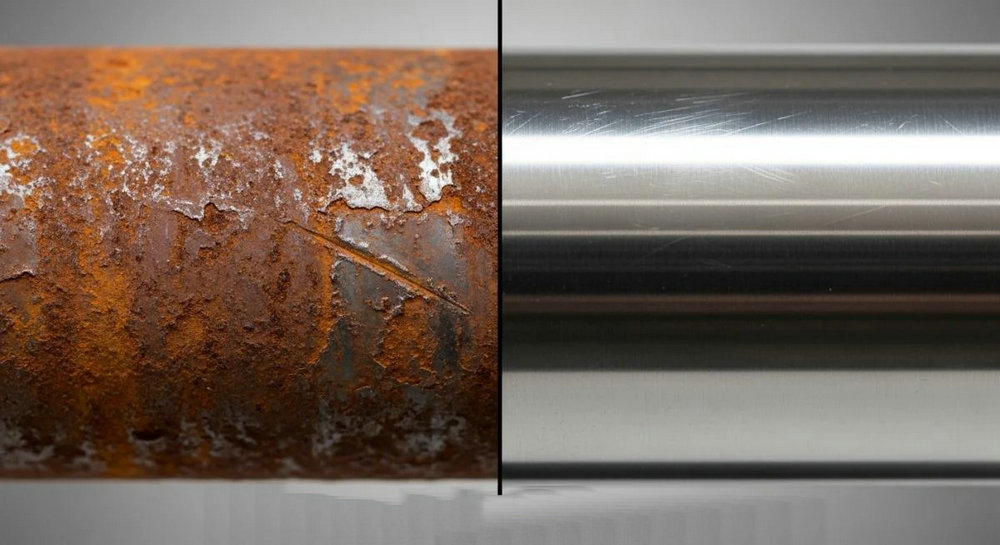
When stainless steel comes into contact with carbon steel, carburization and intergranular corrosion may occur. This is particularly significant in humid environments, where electrochemical corrosion can develop between the two materials.
Stainless steel and carbon steel have a significant potential difference of more than 500 mV. In a humid environment, this potential difference can create a galvanic cell effect. When the two materials are exposed to an electrolyte, such as water, a galvanic cell is formed. The corrosion rate can reach 3–10 times that of the materials when they are used separately, potentially resulting in a corrosion depth of 0.1–0.5 mm per year. Over the long term, this may lead to structural failure.
During high-temperature exposure or welding, carbon atoms from carbon steel can diffuse toward the surface of stainless steel. These carbon atoms can combine with chromium to form chromium carbides, creating chromium-depleted zones along the grain boundaries of stainless steel. As a result, the corrosion resistance and strength of the stainless steel can decrease significantly. Material strength may decrease by approximately 30–50%, potentially causing intergranular corrosion. This type of corrosion can be difficult to detect because the surface may appear intact while internal damage has already occurred.
Carbon steel has a body-centered cubic (BCC) structure, while stainless steel has a face-centered cubic (FCC) structure. Microscopic gaps can exist at the contact interface between the two materials, making it easier for corrosive media to penetrate.
During welding, carbon migration can also create chromium-depleted zones, increasing the risk of intergranular corrosion.
Austenitic stainless steels, such as 304 and 316, contain a significant amount of chromium (Cr), which is essential for their corrosion resistance.
When stainless steel is heated to the sensitization temperature range of 425°C–860°C, carbon can diffuse toward the grain boundaries and react with chromium to form chromium carbide (Cr23C6).
Carbon atoms from carbon steel can diffuse toward the surface of stainless steel. When the local carbon content exceeds 0.08%, chromium carbide can form, resulting in chromium-depleted zones along the stainless steel grain boundaries. This can reduce the material strength by approximately 30–50%.
Carbon steel contains a much higher carbon content than stainless steel. During welding at high temperatures, carbon tends to migrate strongly from the carbon-steel side, where the carbon concentration is higher, toward the stainless-steel side, where the carbon concentration is lower.
This significantly increases carbon enrichment near the fusion line of the stainless steel. As a result, this area becomes more susceptible to chromium carbide formation, which can lead to severe intergranular corrosion.
In a corrosive environment, the welded joint may begin to corrode and crack rapidly along this fusion line.