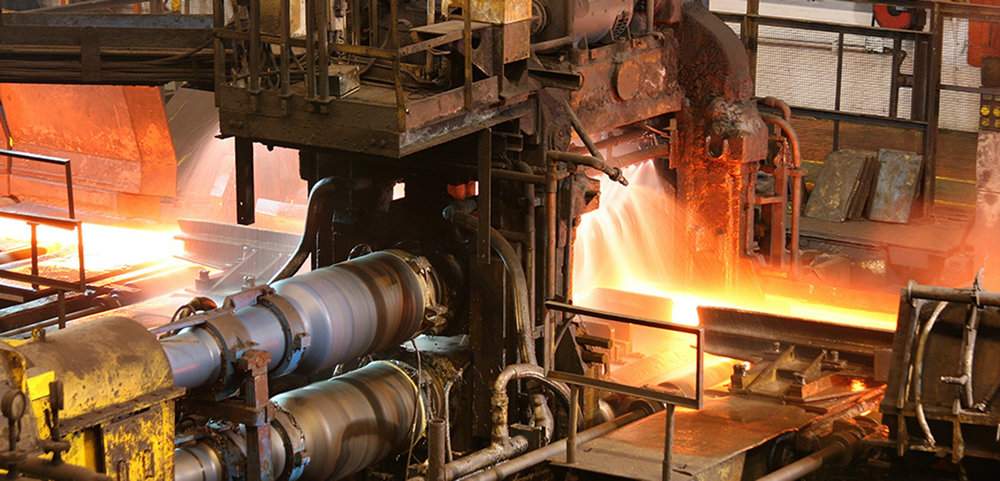
In seamless steel pipe manufacturing, the rolling process directly affects product quality, production efficiency, manufacturing costs, and the range of steel grades that can be processed. Among the major methods, continuous rolling, rotary rolling, longitudinal rolling, and Pilger rolling each have distinct operating principles, equipment configurations, advantages, and applications.
Understanding these differences helps manufacturers select the appropriate production process for specific pipe dimensions, wall thicknesses, material requirements, and production volumes.
Continuous rolling is an advanced, high-efficiency process based on longitudinal deformation. It is widely used for manufacturing seamless pipes that require high dimensional accuracy and consistent production quality.
The process uses multiple rolling stands, typically arranged in a straight line. A hollow billet, also known as a pierced shell, is placed over a long mandrel and passes continuously through the rolling stands. The rotational speeds of successive stands are progressively adjusted to maintain balanced material flow and controlled inter-stand tension.
Representative systems: MPM (Multi-Stand Pipe Mill) with two-roll stands and PQF (Premium Quality Finishing) with three-roll stands.
Rolling stands are arranged with alternating orientations, commonly at 90-degree intervals.
The equipment offers high rigidity and a high degree of automation.
A retained mandrel moves at a controlled speed, typically around 0.8–1.5 m/s, with mandrel lengths of approximately 10–30 m.
Advantages:
High dimensional accuracy, with wall thickness deviation reported at approximately 2–3% and outside diameter tolerances around ±0.2 mm under suitable production conditions.
High production efficiency, with annual output potentially reaching 400,000–600,000 tonnes and rolling speeds of approximately 5–8 m/s.
Favorable compressive stress conditions during deformation, making the process suitable for high-alloy steels, stainless steels, and other difficult-to-deform materials.
Limitations:
High initial equipment investment.
Significant energy consumption.
High mandrel and tooling costs.
Continuous rolling is particularly suitable for small- and medium-diameter seamless pipes, generally below 168 mm in outside diameter, where high precision and high production volumes are required. Typical products include high-pressure boiler tubes, hydraulic tubes, and pipes made from high-strength steel grades.
Rotary rolling, also known as helical rolling, is a process in which the workpiece rotates while moving forward through inclined rolls. It is often selected for products requiring substantial deformation, relatively thick walls, or specialized alloy materials.
The roll axes are inclined approximately 6–12 degrees relative to the rolling line. As the pipe shell passes through the rolls, it simultaneously rotates and advances, following a helical motion that produces the required deformation.
Representative equipment includes two-roll rotary piercing mills and three-roll Assel-type rolling mills.
The equipment structure is relatively simple and lightweight, resulting in lower investment costs.
Three-roll configurations may use rolls arranged symmetrically at 120-degree intervals to form a more enclosed deformation zone.
Advantages:
Strong deformation capability, particularly for thick-wall and large-diameter pipes.
Suitable for high-alloy steels and titanium tubes.
Relatively low investment and tooling consumption.
Flexible production for multiple specifications and smaller batches.
Limitations:
Helical marks may appear on the pipe surface.
Wall thickness accuracy is generally lower than that of advanced continuous rolling systems, with wall thickness deviation reported at approximately 5% or less under the stated process conditions.
Production output is generally lower than that of continuous rolling.
Rotary rolling is suitable for large-diameter, thick-wall seamless pipes, special-alloy tubes, stainless steel pipes, titanium tubes, and small-batch production involving multiple specifications.
Longitudinal rolling is a conventional straight-line rolling process in which the workpiece moves forward without the helical rotation characteristic of rotary rolling. Continuous rolling and CPE push-bench rolling are related processes within the broader family of longitudinal deformation methods.
The roll axes are generally parallel to the rolling line. The workpiece advances through the rolling equipment while its cross-section is reduced and its length increases. Depending on the process configuration, a mandrel may support the hollow shell during deformation to help control wall thickness.
Representative equipment includes continuous rolling mills, CPE push-bench mills, and automatic rolling mills.
The roll pass may be closed or semi-closed, depending on the equipment design.
Mandrel support can be used to control the internal diameter and wall thickness during rolling.
Advantages:
Straight-line material flow promotes longitudinal deformation and grain elongation.
Good roundness and surface finish can be achieved with appropriate process control.
The process avoids the characteristic helical surface marks associated with rotary rolling.
Production efficiency is generally higher than that of rotary rolling, although it depends on the specific equipment and production line.
Limitations:
Performance depends on the mill configuration, tooling, material, and dimensional requirements.
General longitudinal rolling systems do not necessarily achieve the precision or throughput of advanced continuous rolling lines.
Longitudinal rolling is suitable for seamless pipes requiring medium-to-high dimensional accuracy and medium-to-thin wall thicknesses. Common applications include boiler tubes, structural pipes, and small- to medium-diameter pipes produced using CPE and related rolling processes.
Pilger rolling is a periodic pipe-reduction process that combines rolling and forging-like deformation. It is particularly useful for producing large-diameter, thick-wall, and specialized seamless pipes, including products that require substantial reductions in diameter and wall thickness.
The rolls have specially shaped grooves that vary in depth around their circumference. During each roll rotation, a section of the pipe is reduced. The workpiece is then advanced and rotated incrementally before the next section is rolled. Repeated feeding, rotation, reduction, and finishing operations gradually produce the required dimensions.
Representative equipment: two-roll Pilger mills.
A single mill stand can perform substantial deformation that may otherwise require multiple reduction stages.
Product changes can often be made by replacing the roll pair.
The equipment uses a long mandrel and a large working stroke, resulting in a relatively heavy machine structure.
Advantages:
Very high elongation ratios, potentially around 10–20 under suitable conditions.
Large reductions in outside diameter and wall thickness.
The ability to process certain starting materials, including steel ingots, depending on the production route.
Flexibility for producing large, thick-wall, variable-section, and specialized pipes.
Limitations:
Lower production efficiency and a slower operating cycle.
Significant tooling consumption.
Dimensional accuracy may be lower than that achieved by advanced continuous rolling systems, depending on the product and process conditions.
Pilger rolling is commonly associated with large-diameter, thick-wall seamless pipes, variable-diameter tubes, square drill stems, and specialized pipes produced in relatively small batches.
The four processes differ mainly in production efficiency, dimensional accuracy, deformation capability, investment requirements, and suitability for specific products.
| Rolling Process | Main Advantages | Main Limitations | Typical Applications |
| Continuous rolling | High precision, high throughput, consistent production | High investment, energy consumption, and mandrel costs | High-precision boiler tubes, hydraulic tubes, high-strength steel pipes |
| Rotary rolling | Strong deformation capability, flexible production, relatively low investment | Potential helical surface marks, moderate wall thickness accuracy | Thick-wall pipes, large-diameter tubes, high-alloy and titanium tubes |
| Longitudinal rolling | Straight-line material flow, good surface quality and roundness | Performance depends strongly on mill configuration | Boiler tubes, structural pipes, medium-precision seamless tubes |
| Pilger rolling | High reduction ratios, suitable for large and specialized products | Slow production cycle, high tooling consumption | Large-diameter thick-wall pipes, variable-section tubes, special pipes |
Selecting a rolling process requires consideration of pipe diameter, wall thickness, steel grade, dimensional tolerances, production volume, and manufacturing cost.
Choose continuous rolling when high dimensional accuracy, stable quality, and large-scale production are the primary requirements.
Choose rotary rolling when manufacturing thick-wall pipes, difficult-to-deform alloys, or multiple specifications in smaller batches.
Choose longitudinal rolling for general seamless pipe production requiring a balance of dimensional accuracy, surface quality, and production efficiency.
Choose Pilger rolling when very large reductions, thick walls, large diameters, variable cross-sections, or specialized pipe geometries are required.
There is no single rolling process that is best for every seamless steel pipe. The most suitable method depends on the combination of material properties, product geometry, quality requirements, and production economics.
A clear understanding of the four major rolling processes enables steel pipe manufacturers and buyers to evaluate production capabilities more effectively and select manufacturing routes that meet the technical and commercial requirements of each application.