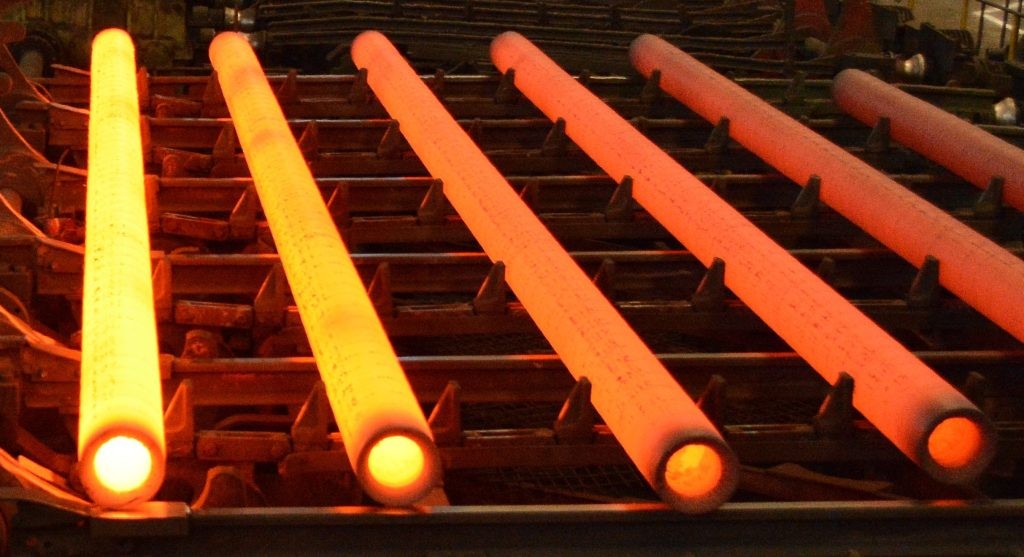
The essence of a stainless steel seamless pipe lies in monolithic material integrity. Without a weld seam - the typical structural weak point - seamless pipes provide superior resistance to high pressure, impact loading, and corrosion uniformity.
In industries with zero-failure tolerance such as oil & gas, nuclear power, aerospace, and defense manufacturing, seamless pipes remain irreplaceable.
In the production chain, seamless pipes sit between:
Round Bar (Solid Billet) → Seamless Pipe → Finished Tubular Products
Unlike welded pipes, which are formed from steel strip or plate, seamless pipes are manufactured from solid round bars. This results in:
Higher energy consumption
More complex deformation processes
Stricter metallurgical control
Greater manufacturing cost
It is a technically demanding vertical segment of the steel pipe industry.
Producing a stainless steel seamless pipe involves two major process families:
Principle:
The round billet is heated to approximately 1200°C and passed between two cross-angled conical rollers rotating at high speed. The compressive forces create internal tensile stress at the center (Mannesmann effect), forming a cavity. A mandrel then pierces through the center.
Result:
A rough hollow shell (hollow billet) is formed. Dimensions are not precise yet, but the pipe structure is established.
After hot piercing, further processing is required for dimensional accuracy and microstructural refinement.
Cold Pilgering
Uses reciprocating grooved dies
Gradually reduces wall thickness
Highest dimensional accuracy
Produces very dense microstructure
Cold Drawing
Pipe is pulled through a die
Faster process
Slightly wider wall thickness tolerance compared to pilgering
Final Objectives:
Tight tolerances (as precise as ±0.05 mm)
Improved surface finish
Refined grain structure
Enhanced mechanical performance
For high-pressure applications, internal stress distribution is non-uniform. According to Lame’s Equation for thick-walled cylinders:
σθ = [Pi ri² / (ro² − ri²)] · [1 + (ro² / r²)]
Where:
σθ = circumferential (hoop) stress
Pi = internal pressure
ri = inner radius
ro = outer radius
r = radial position
Key Insight:
The inner wall experiences significantly higher stress than the outer wall.
If a pipe contains a weld seam — which inherently has microstructural heterogeneity — stress concentration may occur at microscopic defects. Under high pressure, these localized stress amplifications can trigger failure.
Seamless pipes, due to their isotropic and homogeneous structure, distribute stress uniformly and greatly reduce the risk of burst failure.
Seamless pipes are more expensive than welded pipes for several reasons:
Raw Material Premium
Seamless pipes require round bar billets. Due to continuous casting differences, round bars typically cost more than strip steel of the same grade.
Lower Yield Rate
Center scrap during piercing
Head and tail cutting during cold rolling
Multiple processing passes
Typical yield rate:
Seamless pipe: 75%–80%
Welded pipe: approximately 97%
High Energy Consumption
Each cold rolling or drawing stage requires solution annealing to restore ductility.
More passes mean more heat treatment cycles and higher electricity and pickling costs.
In some markets, welded pipes are polished to remove visible weld seams and sold as seamless pipes. Here are practical identification methods:
Check Eccentricity
Welded pipes have extremely uniform wall thickness because they originate from flat strip.
Seamless pipes typically show slight eccentricity due to mandrel offset during piercing.
If four-point wall thickness measurements show deviation less than 0.01 mm, the pipe is highly likely to be a disguised welded pipe.
Acid Etch Metallographic Test
Cut a cross-section sample.
Perform acid etching for about 10 minutes.
Results:
Welded pipe: A lighter longitudinal line appears at the weld zone due to microstructural difference.
True seamless pipe: Completely uniform color and structure around the circumference.
This method is highly reliable for professional verification.
Stainless steel seamless pipes represent a metallurgical solution for high-risk, high-pressure environments.
Their structural continuity, isotropic microstructure, and superior stress distribution make them indispensable in critical industrial systems.
When failure is not an option, seamless pipe is not just preferred - it is required.