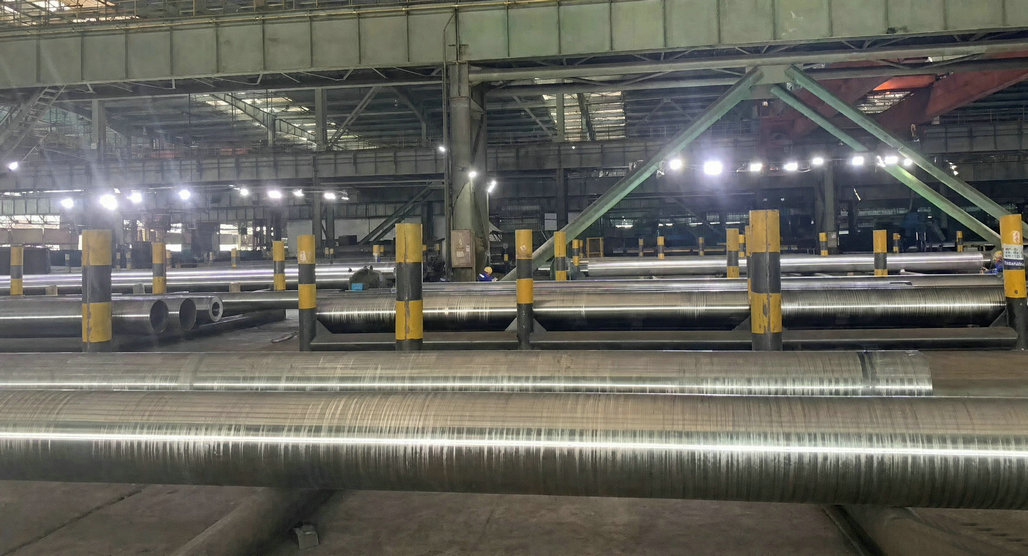
In the inferno of refining catalytic units and the heat waves of power-station boilers, a tough, heat-resistant metal backbone supports high-temperature, high-pressure processes - the P5 seamless steel pipe. As a key component of modern high-temperature, high-pressure systems in power generation and petrochemicals, this seamless steel pipe carries a lasting mission under severe operating conditions. This article systematically explains the "past and present" of P5 seamless pipe, including its core definition, equivalent materials, composition, processing and broad application scenarios.
What Is P5 Seamless Steel Pipe? Decoding the Soul of the Alloy
P5 seamless steel pipe, often known by the industrial designations "ASME SA-335 P5" or "ASTM A335 P5," is in essence a chromium-molybdenum ferritic alloy seamless steel pipe produced in strict accordance with the dual authoritative standards of the American Society of Mechanical Engineers (ASME) and ASTM International - A335/SA-335.
The manufacturing process is based on modern hot-rolled (or cold-rolled) seamless forging. The basic steps can be summarized as follows: "preheating of high-quality steel billet → precision piercing → finish rolling and shape control → high-quality cooling → strengthening and straightening → strict inspection → warehousing and circulation." Among these, heat treatment is the soul of the process. Through solution and aging processes (such as quenching plus stabilized tempering), a large number of thermally strong dispersed phases such as tempered bainite are precipitated in the steel matrix, ensuring that P5 seamless steel pipe has extremely high resistance to deformation and a high-temperature creep limit in the 500–550°C environment. This process not only greatly raises the strength ceiling of the pipe body but also gives the material significant low-temperature oxidation resistance and resistance to chloride ion stress corrosion, enabling it to serve long-term in highly sulfurous and hydrogen-containing extreme corrosive atmospheres without retreat.
According to the P5 specification, the outer diameter coverage of the pipe is very wide. From small-diameter pipes of 14 mm to thick diameters of 820 mm, both stock and custom sizes are available; wall thickness ranges from 4 to 60 mm to meet different structural rigidity and flow capacity matching requirements. When calculating its quality assurance parameters, the industry widely uses the mass coefficient method: the formula is: mass per meter (kg) = (pipe diameter D mm − thickness t mm) × t mm × 0.02483 (specific steel density coefficient). This formula provides a concise and efficient mathematical tool for material pressure budgeting in engineering design, thereby achieving accurate pre-control of over-design conditions and reducing operation and maintenance economic losses caused by equipment failure.
The Soul of Material Composition: The Chrome-Moly Formula and Compatibility with Domestic Substitutes
As a benchmark product among alloy steel pipes, the "steel-tough bloodline" of P5 seamless steel pipe is laid down by its basic metal formula.
According to the standard chemical table requirements of ASTM A335/AEES, the chemical testing of cast samples in the melting furnace must fall precisely within the following windows:
Carbon C: upper limit 0.15%, ensuring sufficient carbon content to increase the smelting hardness of the steel.
Manganese Mn: recommended range 0.3–0.6%, used to enhance toughness and offset the negative effects of sulfide-induced brittleness. Phosphorus P/Sulfur S: not exceeding 0.025% each (dual strictness) to suppress hydrogen-induced hot cracking and extend the corrosion resistance cycle.
Silicon Si: not exceeding 0.50%. It both improves the fluidity of molten steel and acts as an "oxidation barrier" at grain boundaries, enhancing high-temperature oxidation resistance, especially in nitrogen-containing atmospheres.
Chromium Cr (core alloying element): baseline 4%–6%. Through the oxide film effect and solid-solution strengthening of Cr, it significantly strengthens corrosion resistance (especially to hydrogen sulfide and hydrogen chloride), ensuring superior temperature oxidation limits below 600°C.
Molybdenum Mo (another core alloying element): standard range 0.45%–0.65%, aimed at refining the grain size of the steel, improving high-temperature endurance strength (creep rupture toughness), and significantly reducing the tendency of grain sliding under long-cycle high-temperature pressure.
In terms of equivalent substitution, "12Cr5Mo" is the common national-standard equivalent designation internationally, and it perfectly fits the main composition design framework of P5 seamless pipe - a 5%-level Cr with a medium Mo content scheme. Among domestic Chinese material designations, 12Cr5Mo alloy pipe is also in the same family as AISI grade 502 steel (ISO/TS grade), and is recommended as a high-temperature pipeline material in the domestic boiler code (GB5310), achieving full compatibility with P5 alloy pipe in hydrogen resistance, oxidation resistance and creep limit indicators. It should be noted that when substituting, the allowable pressure stress values should be reviewed with reference to actual service conditions, pipe wall thickness parameters and other factors to ensure an absolutely "seamless" functional conversion.
Excellent Performance of P5 Seamless Pipe and Industrial Deployment Strategy
Its excellent high-temperature service performance has found an irreplaceable place in severe scenarios such as petrochemical energy and thermal power generation boilers.
High-Temperature Mechanics
Mechanical test data specified by ASTM A335 show the following calibrated parameters for P5 seamless pipe:
Yield strength (Ys): ≥205 MPa, which is 130%–160% of the high-temperature performance of conventional low-alloy pipes (such as A106). This advantage ensures that the pipeline structure will not suffer permanent damage under extreme conditions such as seismic loads, with a guaranteed safety factor.
Tensile strength (Ts): lower limit ≥415 MPa (corresponding to 60,000 lbf/in²), meaning that under the same service load, the pipe wall thickness can be reduced by 20%, correspondingly reducing overall equipment weight, reducing structural load and optimizing manufacturing costs.
Extensibility and macroscopic hardness tests show that under fully tough conditions the longitudinal elongation reaches 30%, while surface Brinell/Rockwell hardness does not exceed 179 HB (or 89 HRB), which gives the pipe good mechanical formability, including elbow stamping or hot fusion butt joining.
With this series of superior mechanical conditions, P5 seamless pipe is mainly deployed in the four "temperature peak zones" of boiler structures:
Core heating section tube bundles of petroleum distillation towers: especially the temperature-controlled pipelines through which heavy oil flows (480–600°C), using the dual advantages of Cr oxidation stability and Mo phase strengthening to effectively slow down wall loss caused by sulfide corrosion. Such equipment is most typically represented by heating elements in hydroreforming units.
Steam superheating components of power stations (especially coal-fired power generation): main piping, headers and temperature reheaters and other core transmission components widely use custom-sized P5 large-diameter, heavy-wall steel pipes. They withstand ultra-high temperatures above 580°C and strong pressures above 13 MPa (i.e., over 130 engineering atmospheres), ensuring stable high pressure and efficient operation of steam entering the turbine.
High-parameter transmission pipelines requiring high thermal insulation protection in specialty industries (such as nuclear power auxiliary steam supply pipes or solar thermal energy storage loops): the oxidation resistance, good weldability and consistent heat-treated structure of P5 seamless pipe material enable safe and stable medium-grade temperature service.
In summary, through its precise metal formula system design, refined heat treatment technology, diversified physical diameter sizes and excellent service potential adapted to high-temperature environments, P5 seamless pipe has built a solid defense line in high-risk corrosive industries such as global energy transmission and petrochemical distillation - maintaining the pulse of temperature amid steel flames, making metal pipelines an artistic masterpiece spanning steam and fire. With the implementation of carbon emission reduction targets at home and abroad and the further upgrading of high-temperature, high-pressure system performance, it is believed that the application range of such superior seamless pipe materials will usher in broader and more finely segmented demand growth, continuing to contribute a solid heat carrier and river of flow to modern industry.