In room-temperature corrosive environments, 316L is the clear winner. However, under high-temperature conditions, the situation becomes more nuanced.
Although 316L theoretically has slightly better high-temperature strength than 304, the presence of molybdenum (Mo) introduces a hidden risk. At temperatures above 800°C, molybdenum can undergo catastrophic oxidation, where molybdenum oxides volatilize, causing rapid material thinning.
Therefore, for applications such as high-temperature furnace tubes (without corrosive gases), lower-cost 304, or specialized grades like 321 or 310S, may actually perform better than 316L.
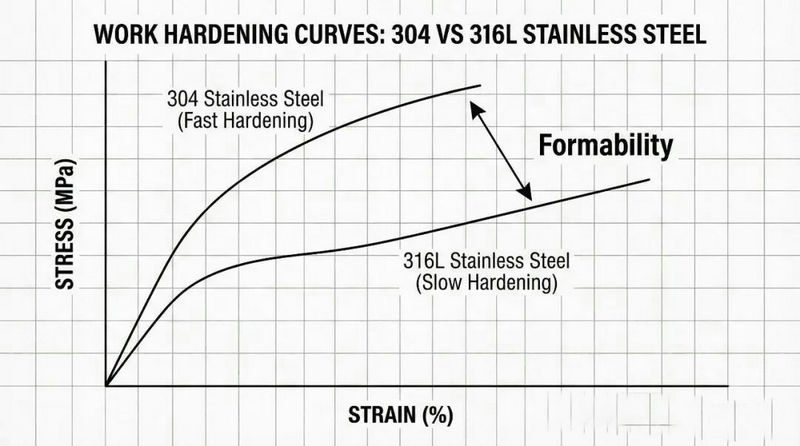
During stamping and forming processes, operators often observe that 304 hardens more easily than 316L.
This is due to its lower stacking fault energy (SFE), which promotes strain-induced martensitic transformation during deformation.
As a result:
304 becomes harder and stronger
Magnetism increases after forming
Springback becomes more significant
In contrast, 316L contains a higher nickel content (10–14%), resulting in:
Higher stacking fault energy
Extremely stable austenitic structure
Minimal magnetism even after heavy deformation
Lower work hardening rate
While 316L offers superior properties, nickel and molybdenum are expensive alloying elements, making it significantly more costly than 304.
Cost-sensitive applications
For sinks, cookware, and indoor decorative components, 304 provides far better cost-performance.
Non-magnetic requirements
For applications like MRI equipment components or sensitive electronic devices, 316L (or 316LN) is essential, as 304 can become magnetic after processing.
| Property | 304 | 316L | Notes |
| Pitting Resistance (PREN) | ~18 | ~24 | 316L is better |
| Work Hardening Rate | High | Low | 316L easier for deep drawing |
| Magnetism After Processing | Slight | None | 316L is superior |
| High-Temperature Oxidation | Moderate | Use caution above 800°C | Mo volatilization risk |
Check the environment
If chloride ions are present (e.g., seaside, swimming pools, soy sauce, vinegar), choose 316L.
Check the process
For deep drawing without intermediate annealing, 316L may reduce scrap rates despite higher material cost.
Check magnetic requirements
If absolute non-magnetic properties are required, 316L is the only choice.