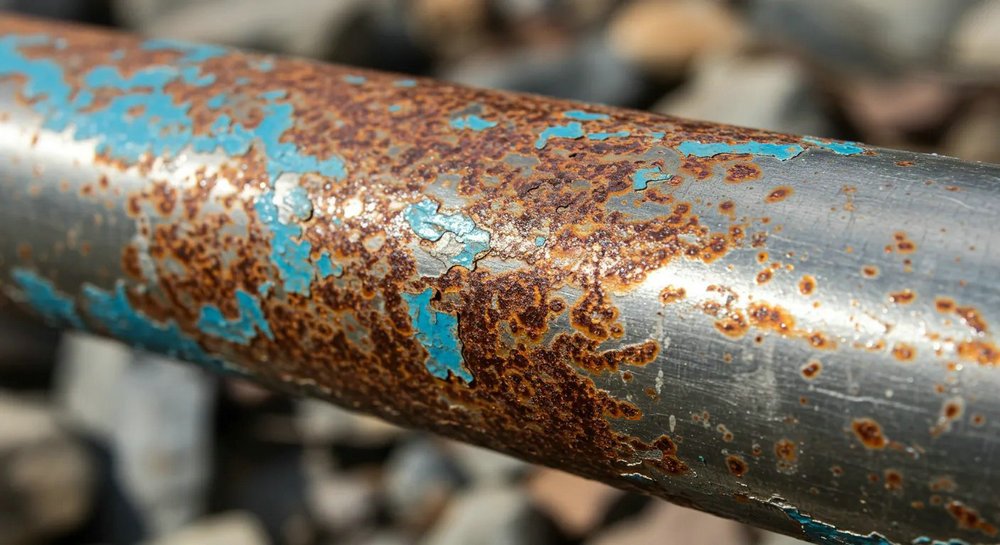
The Biggest "Myth" About Stainless Steel: If It Rusts, Is the Material Defective?
"Boss, why is this 304 stainless steel rusting? It must be fake!"
This is one of the most common disputes in the stainless steel world. The biggest misunderstanding about stainless steel lies in interpreting the word "stainless" as meaning absolute and permanent resistance to rust. However, from a materials science perspective, being rust-free is temporary - corrosion is the natural end state.
In English, stainless steel literally means "less likely to stain". By adding more than 12% chromium (Cr), a very thin chromium oxide passive layer forms on the surface.
This layer is not armor-it is more like "biological skin". It is extremely thin, transparent, and self-healing. As long as oxygen is present, even if scratched, it can regenerate. The so-called "stainless" property is essentially the corrosion rate being reduced to a level invisible to the naked eye.
Rust is not a scam-it is the result of the passive layer failing under environmental stress:
(1) Chloride Ion Attack
Chloride ions (Cl⁻) are the biggest enemy of stainless steel. Found in coastal environments and cleaning agents, they can penetrate the passive layer and cause pitting corrosion. Even 304 stainless steel can fail in salt spray conditions.
(2) Chromium-Depleted Zones
During welding or improper heat treatment, carbon reacts with chromium to form chromium carbides. This reduces chromium content at grain boundaries, creating weak spots that lead to intergranular corrosion.
(3) Contamination from Foreign Particles
Carbon steel dust settling on stainless steel surfaces can create galvanic corrosion in humid environments. In such cases, the rust actually originates from external contamination.
When users feel deceived, it is often due to low-quality materials:
High Manganese Steel (e.g., some 201 grades):
Used as a cheaper substitute for nickel. While visually similar, it has poor corrosion resistance, especially in acidic or humid conditions. Selling it as 304 is the real industry scam.
Industrial Grade vs Food Grade:
Even if composition meets standards, excessive heavy metal migration can make it unsuitable for food applications.
Perceived failure often comes from incorrect material selection:
Indoor / Inland Use: 304 is cost-effective and sufficient
Coastal / Chemical Environments: 316 (with molybdenum) is required for better chloride resistance
High-End Applications: Advanced alloys like Hastelloy or duplex stainless steel may be needed
Discussing stainless without considering the environment is fundamentally misleading.
Rusting is not a failure of science-it is a manifestation of the second law of thermodynamics. Materials engineering is not about achieving absolute permanence, but about balancing cost, performance, and environment.
So next time you see rust on stainless steel, don't rush to call it a scam. Instead, ask:
Has the passive layer been exposed to conditions beyond what it was designed to handle?