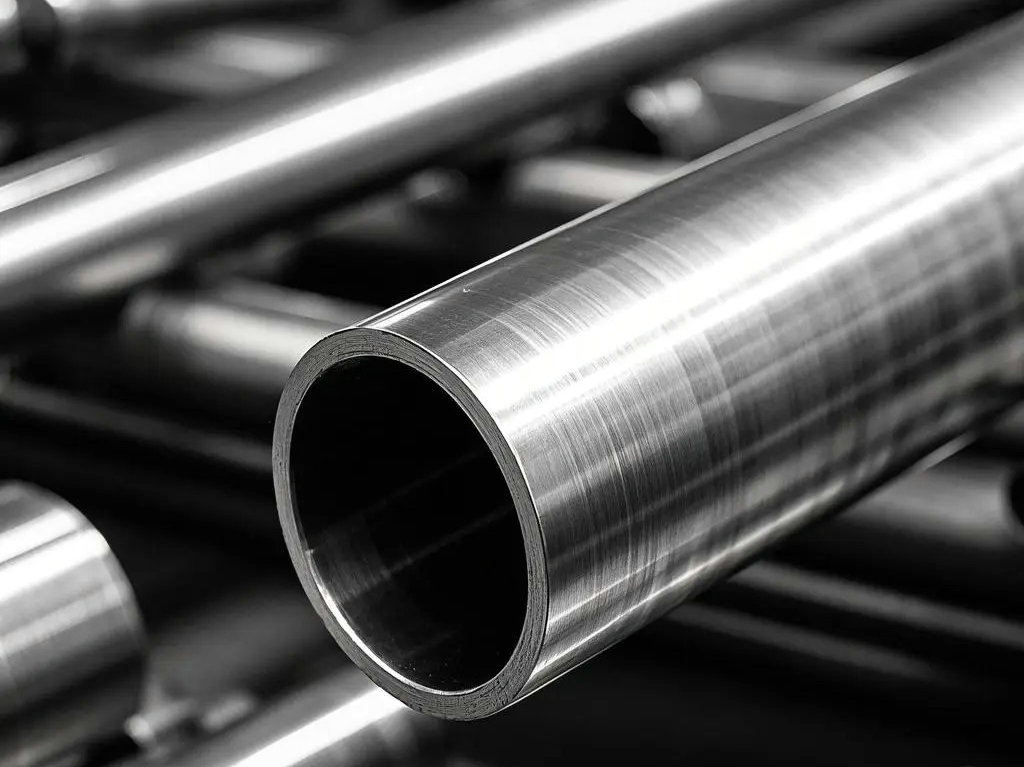
If you work with precision steel tubes, you have almost certainly been asked: which is better, cold drawn tube or cold rolled tube? Why does the price differ so much for the same specification? Which one should be selected for hydraulic systems or automotive components? Today we will explain everything in plain language - from principles, precision and performance to selection guidelines. All practical insights. After reading this, you will never fall into the wrong choice again.
First, understand the most fundamental deformation logic. One sentence is enough to remember it:
Cold Drawing (Drawing): Forming by "Pulling"
At room temperature, the steel tube is forced through a smaller die, much like squeezing a foot into a smaller shoe. Axial tensile force pulls the tube to become smaller and longer. Single-pass deformation is small (10%–20%), so repeated drawing plus annealing is required; otherwise, the tube may crack directly.
Cold Rolling (Rolling): Forming by "Compressing"
The steel tube is placed between multiple rollers and rolled back and forth. Radial compression plus axial extension causes the wall thickness to decrease uniformly, much like rolling dumpling dough evenly. Single-pass deformation is large (40%–70%), fewer passes are required, and efficiency is higher.
Simply put: cold drawing "pulls it thinner," while cold rolling "rolls it thinner." The force application methods are completely different, which directly determines all subsequent performance characteristics.
For precision tubes, the most valued characteristics are "accurate dimensions and bright surface." The gap between the two processes is very obvious:
Outer Diameter Tolerance: Cold drawn ±0.05–±0.1 mm; cold rolled ±0.02–±0.05 mm (more precise)
Wall Thickness Deviation: Cold drawn ±5%–8% (prone to uneven thickness); cold rolled ±3%–5% (uniformity maximized)
Concentricity: Cold drawn: average; cold rolled: excellent, not prone to eccentricity
Surface Roughness: Cold drawn Ra 0.8–1.6 μm (with drawing marks); cold rolled Ra 0.2–0.4 μm (mirror-level, smooth to the touch)
Key point: If you need precision and a mirror finish, choose cold rolled; if only outer diameter accuracy is required, cold drawn is sufficient.
Different force application methods lead to very different mechanical properties, which directly affect service life:
Cold Drawn Tube:
Strong work hardening and high tensile strength, but poor plasticity—hard and prone to cracking. Axial strength is far greater than radial strength, with obvious anisotropy and high residual stress. Subsequent bending, flaring and welding are prone to cracking and deformation.
Cold Rolled Tube:
Uniformly refined grains and a well-balanced combination of strength and plasticity—both strong and tough. Good isotropy, strong fatigue resistance, low residual stress. Secondary processing can be performed freely with minimal deformation.
In one sentence: cold drawn is "rigid," cold rolled is "stable." For dynamic operating conditions and secondary processing, cold rolled is the necessary choice.
Stop struggling over "which one is better." The one that suits your working conditions is the best. Use the following for direct reference:
Choose Cold Drawn Tube in These 4 Situations:
Small batch, non-standard customization, short-length replenishment orders—flexible die changes and fast delivery;
Small diameter (Φ6–Φ76), medium-to-thick wall tubes, requiring only outer diameter accuracy and high strength;
General mechanical structures, construction supports, low-cost requirements, limited budget;
Average requirements for inner wall smoothness and wall thickness uniformity, with no complex secondary processing.
Choose Cold Rolled Tube in These 5 Scenarios:
Large-scale standardized production, core components for hydraulic, pneumatic and precision machinery;
Small-to-medium diameter thin-wall tubes requiring uniform wall thickness, high concentricity and clean, scratch-free inner walls;
Subsequent bending, flaring, welding, or exposure to alternating loads and high-pressure conditions;
High-end applications such as automotive shock absorbers, gearbox oil pipes and aerospace hydraulic conduits;
Precision equipment pursuing mirror surfaces, low residual stress and long-term stable operation.
Small diameter, thick wall, strength required, cost controlled → cold drawn; thin wall, high pressure, mirror finish required, stable performance → cold rolled.
There is no absolute good or bad between the two processes—only whether they fit. Understand the principles, clarify your needs, and you will select without hesitation and without wasting money.