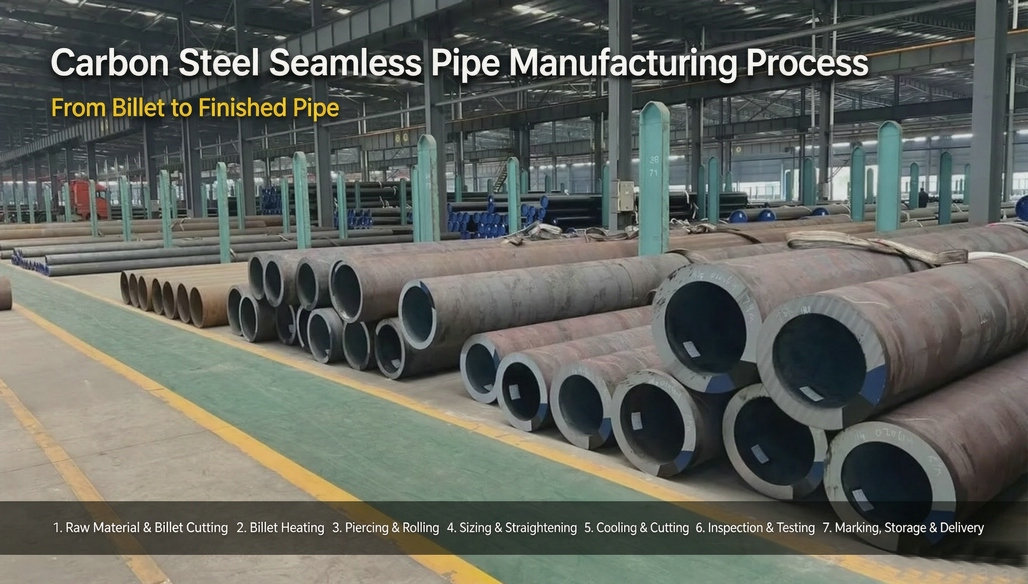
In machinery manufacturing, fluid transportation, pressure vessel construction, and other core industrial sectors, carbon steel seamless pipes remain an irreplaceable foundational material. Their unique advantages—no weld seam, high pressure-bearing capacity, and uniform microstructure—make them indispensable for demanding applications.
As someone who has worked in raw material procurement for several years, I frequently purchase seamless steel pipes. Yet I never had the chance to fully map out the complete production flow. Recently, with a bit of downtime, I organized and studied the relevant process knowledge and want to share it with fellow professionals. I am not a technical expert, so if anything in this article is inaccurate or poorly expressed, your understanding is appreciated.
Carbon steel seamless pipe production generally follows the core logic of "billet → piercing → forming → finishing." Depending on forming temperature and processing method, it is divided into two major systems: hot rolling and cold drawing (cold rolling). Each serves different specification ranges and precision requirements.
Hot rolling is the dominant production method, accounting for more than 80% of total seamless steel pipe output. Cold drawing and cold rolling serve as precision-oriented supplements for applications such as precision machinery, hydraulic systems, and automotive components.
Raw materials are mainly continuous casting round billets or rolled round bars. Common carbon steel grades include 10#, 20#, 35#, Q235, and Q355B. Boiler-specific applications use grade 20G. After arriving at the mill, each billet undergoes three pretreatments:
● Surface grinding: removes surface defects such as cracks, scabs, and folds.
● Internal flaw detection: ultrasonic testing identifies shrinkage cavities, gas pores, and inclusions.
● Fixed-length sawing: billets are cut to multiple lengths, with end-face perpendicularity controlled to ≤2 mm.
Billets are charged into a continuous rotary hearth furnace and heated progressively through preheating, heating, and soaking zones. For carbon steel piercing, the temperature is controlled at 1,200–1,250°C, with soaking-zone fluctuation kept within ±20°C. This ensures uniform through-thickness heating and prevents burning or low-temperature piercing defects.
Piercing is the most critical step in seamless pipe production. The Mannesmann two-roll oblique piercing mill is the industry standard. Two rolls rotate in the same direction at an inclination of 8°–15°. As the billet advances in a spiral motion, it is simultaneously compressed radially and stretched axially. The center metal forms a cavity due to the transverse forging effect, and a piercing plug completes the hollow shell.
After piercing, the shell length is about 1.5–2 times the original billet length. The initial wall-thickness deviation formed at this stage directly affects final product accuracy.
The pierced shell enters either an automatic pipe rolling mill or a retained mandrel continuous rolling mill (MPM). A mandrel is inserted into the shell, and multiple stands roll it continuously to reduce wall thickness and outer diameter. This greatly improves wall-thickness uniformity and surface quality.
Retained mandrel continuous rolling is currently the most advanced process. Wall-thickness accuracy can reach within ±5%, and production efficiency is more than 30% higher than traditional automatic pipe rolling mills.
The rolled pipe is fed into a sizing mill with 3–12 stands for mandrel-free rolling to precisely control outer diameter. For smaller sizes, a reducing mill performs multi-stand continuous diameter reduction. After sizing, outer-diameter tolerance can be controlled to approximately ±0.1 mm, providing a solid foundation for downstream finishing.
● Cooling: pipes cool naturally or by forced air on cooling beds from about 800°C to room temperature, completing the austenite-to-ferrite/pearlite phase transformation.
● Straightening: multi-roll straighteners apply reverse bending to correct curvature from rolling and cooling, ensuring straightness ≤1.5 mm/m.
● Cut head and tail: remove end sections with uneven wall thickness or inner folding.
● Surface treatment: shot blasting or pickling removes iron oxide scale.
● Non-destructive testing: ultrasonic testing (UT) detects internal defects; eddy-current testing (ET) detects surface cracks.
● Physical and chemical testing: tensile, impact, and hardness tests verify mechanical properties.
● Dimensional re-inspection: every pipe is measured for outer diameter, wall thickness, and ovality.
● Marking and packaging: grade, specification, standard number, and heat batch number are stenciled on; pipes are oiled for rust prevention and stored.
For small-diameter, thin-walled pipes requiring high dimensional accuracy and excellent surface finish, cold working is performed on the basis of hot-rolled shells. The core cold-drawing process flow is:
Hot-rolled shell → pickling → phosphating/saponizing → heading and pointing → cold drawing → stress-relief annealing → straightening → precision cutting → final inspection
Key technical points:
1. Pickling and phosphating: removes oxide scale and forms a lubricating film, reducing drawing resistance and preventing surface scratches.
2. Multi-pass drawing: each pass reduces diameter by 10%–20%, with intermediate annealing between passes to eliminate work hardening.
3. Dimensional accuracy: finished outer-diameter tolerance can reach ±0.05 mm, and inner-surface roughness Ra ≤1.6 μm—far better than hot-rolled pipe.
4. Final annealing: stress-relief or full annealing is selected according to service requirements to adjust hardness and ductility.
Cold-drawn pipes are widely used in hydraulic cylinders, pneumatic cylinders, precision mechanical structural parts, and automotive components. They are typically produced to GB/T 3639.
Understanding the difference between hot-rolled and cold-drawn seamless pipe helps you choose the right product for your project.
| Process Type | Forming Temperature | Typical Size Range | Dimensional Accuracy | Core Advantages |
Hot-rolled seamless pipe | 1,200–1,250°C | φ32–630 mm; wall thickness 2.5–70 mm | ±0.5 mm class | Large diameter, thick wall, low cost, high output |
Cold-drawn/cold-rolled seamless pipe | Room temperature | φ4–114 mm; wall thickness 0.5–12 mm | ±0.05 mm class | High precision, high surface finish, uniform mechanical properties |
The manufacture of carbon steel seamless steel pipe is essentially a combination of hot deformation and cold deformation. Under the premise of maintaining metal-structure continuity, manufacturers precisely control geometric dimensions and mechanical properties. From 1,200°C red-hot steel billets to mirror-bright precision products, every process represents the deep integration of materials science and mechanical engineering.
For procurement and mechanical-design professionals, understanding the manufacturing process not only supports better sourcing decisions but also enables you to predict material behavior and optimize processing schemes during the design stage - ultimately improving product reliability from the ground up.
None